Your Checklist for Hybrid Events in Munich
How can you pull off a hybrid event where all guests feel equally engaged? Anyone planning an event where part of the audience attends in person and another part participates digitally faces unique challenges. After all, a camera in the event space and a working livestream alone do not make for a successful hybrid event.
It’s important that both groups of participants feel they are equal parts of the event. This requires a well-thought-out concept, the right technology, and a suitable hybrid event venue in Munich.
Our checklist outlines what matters most—from initial planning through to follow-up.
1. Two Target Audiences, One Shared Event Experience
At a traditional in-person event, attention is focused on the audience in the room. At a hybrid event, however, there are two groups with different circumstances and expectations. While on-site guests experience the atmosphere firsthand and can interact in person during breaks, online participants follow the proceedings on a screen. They rely more heavily on video, audio, and a varied presentation.
The most important rule, therefore, is this: A hybrid event must be designed for both groups of participants from the very beginning. Anyone who views digital participation merely as an additional broadcasting option is squandering potential.
Checklist:
- Have the needs of both participant groups been taken into account during planning?
- Can online guests actively participate in the event?
- Is the program understandable and interesting even without in-person attendance?
- Is there a clear communication strategy for both target audiences?
2. Hybrid Event Venue in Munich: The Right Space Makes All the Difference
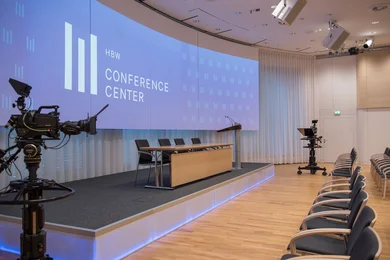
The choice of venue has a significant impact on how well a hybrid event works. In addition to size, accessibility, and amenities, the technical capabilities are particularly important. A professional hybrid event venue in Munich should offer more than just a high-speed internet connection. It’s also essential to have the right conditions for camera positions, lighting, sound systems, and the integration of digital participants. Here at the hbw Conference Center, you’ll find the ideal conditions!
Checklist:
- Is there a stable internet connection with sufficient upload capacity?
- Is professional camera, lighting, and audio equipment available or can it be integrated?
- Can presentations be displayed clearly both in the room and via livestream?
- Are there sufficient connections and suitable locations for the event technology?
- Are there opportunities for technical rehearsals and smooth production operations?
Anyone looking for hybrid meeting rooms in Munich should therefore consider more than just the room size or the list of amenities. An early site visit and coordination with the technical staff help avoid surprises later on.
3. Good sound quality is more important than many people realize
A slightly blurry image can be tolerated for a short time. Poor sound, on the other hand, can quickly make an event exhausting for online guests. If questions from the audience can’t be understood, microphones fail, or the audio is transmitted with a delay, digital participants will lose track of what’s happening. That’s why it’s not just moderators and speakers who should be equipped with suitable microphones. Comments from the audience must also be reliably transmitted to the livestream.
Checklist:
- Are all speakers and panelists easy to understand?
- Are questions from the audience transmitted via microphones?
- Has the audio quality been tested separately for online guests?
- Have potential echoes, feedback, and distracting background noise been addressed?
- Are there suitable backup solutions in place for critical technical issues?
4. Actively Engage Online Guests Instead of Just Letting Them Watch
One of the biggest challenges of hybrid events is ensuring that digital participants don’t become passive spectators. Those attending in person can react spontaneously, ask questions, or interact with others. Online guests need appropriate digital tools to do the same. Live polls, moderated chats, or digital Q&A sessions encourage participation. However, it’s crucial that these contributions are actually incorporated into the event.
Checklist:
- Is there a way to submit questions digitally?
- Are online questions treated on an equal footing with questions from the audience?
- Are interactive elements such as surveys or polls planned?
- Is there a designated person responsible for moderating the chat?
- Are digital requests to speak visibly acknowledged by the moderator?
Practical Tip: Make a point of including questions from the digital audience. A phrase like “We now have a question from our livestream” signals to online guests that they are an important part of the event.
5. The moderator must bridge both worlds
In a hybrid event, the moderator plays a particularly important role. They not only guide the audience through the program but also connect the in-person audience with those watching on screen.
This begins right from the welcome. Addressing only the guests in the room unintentionally makes the digital audience feel like they’re playing a secondary role. Both groups should also be acknowledged regularly throughout the event. Close coordination between the moderator, production team, and chat moderators helps ensure this.
Checklist:
- Are in-person and online guests explicitly welcomed?
- Is the host familiar with the digital engagement options?
- Are transitions between presentations, discussions, and interactive elements coordinated?
- Are there clear agreements with the technical production team?
- Are reactions and questions from both groups taken into account?
6. Plan Breaks and Networking Opportunities for Everyone
For many participants, face-to-face conversations are a key reason for attending an event. This is precisely where an imbalance often arises in hybrid events: While on-site guests chat over coffee or lunch, online participants may only see a break screen. It doesn’t have to be that way! Digital networking spaces, moderated discussion groups, or short interviews during breaks can create additional opportunities to connect. However, not every break needs to be filled with activities. Online participants also need time to relax.
Checklist:
- Are there suitable networking opportunities for online guests?
- Are break times clearly communicated to both groups?
- Are important discussions or program items offered exclusively outside the live stream?
- Are there opportunities for in-person and online participants to interact with one another?
7. Technical rehearsals and an emergency plan are mandatory
Even the best planning cannot protect against a potential technical glitch. What matters most is how well organizers are prepared for such situations! That’s why a full test run should take place before the event begins. This involves checking not only cameras and microphones but also presentations, video clips, digital connections, and transitions between different program segments. It’s especially important to consider what happens if a connection is lost or a speaker cannot be connected at the last minute.
Checklist:
- Was a full technical rehearsal conducted?
- Have all presentations, videos, and remote connections been tested?
- Are there designated points of contact for technical issues?
- Have responsibilities and communication channels been clarified in case of a malfunction?
- Is there a plan in place for connection drops or the failure of key components?
8. After the event is before the next event
The event isn’t completely over once the livestream ends. Hybrid formats, in particular, offer additional opportunities to make content available for the long term. For example, recordings, individual talks, or presentations can be made available afterward—provided the necessary consents and usage rights have been obtained. Participant feedback is just as important. It’s worth evaluating the experiences of online and in-person attendees separately.
Checklist:
- Are both groups of participants asked for feedback?
- Can technical and organizational issues be traced?
- Can recordings or presentations be made available afterward?
- Are insights documented for future events?
Conclusion: Your hybrid event in Munich offers more than just a livestream!
Hybrid events give companies and organizations the opportunity to bring people together regardless of their location. For this to succeed, technology, venue design, moderation, and participant communication must all work in tandem.
The goal is not to offer online and in-person guests exactly the same experience. Rather, it’s about enabling both groups to participate on an equal footing—with offerings tailored to their respective needs.
A professionally equipped hybrid event venue in Munich provides an important foundation for this. Equally crucial are careful preparation, reliable technical support, and an event concept that takes all participants into account from the very beginning.
Are you planning a hybrid event in Munich? mbw supports you with planning and technical implementation—so that your messages reach your audience both in the event venue and online.
